Galvanic cell : A type of battery made up of electrochemicals with two different metals connected by a salt bridge.
👇 ស្វែងរកឯកសាររៀននិងការងារគ្រប់ប្រភេទនៅទីនេះ៖
👇 ស្វែងរកពាក្យផ្សេងទៀតនៅប្រអប់នេះ៖
ACCA, MBA, Tax Agent ជាអ្នកនិពន្ធហើយអាចប្រលងជាប់៖ ACCA រហូត ៤ មុខវិជ្ជាក្នុងពេលតែម្តង, Tax Agent ពិន្ទុខ្ពស់, MBA & BBA ជាប់ជាសិស្សពូកែ និងមានបទពិសោធការងារជាង ១៥ ឆ្នាំ ព្រមទាំងអ្នកនិពន្ធផ្សេងៗ ?ទិញឯកសារហើយ អានមិនយល់អាចសួរបាន
Galvanic cell : A type of battery made up of electrochemicals with two different metals connected by a salt bridge.
Gas : One of the four fundamental states of matter, characterized by high-energy particles which fill their container but have no definite shape or volume.
Freezing point :
The temperature at which a substance changes state from a liquid to a solid. Because freezing is the reverse of melting, the freezing point of a substance is identical to its melting point, but by convention only the melting point is referred to as a characteristic property of a substance.
Frequency : A measurement of the number of cycles of a given process per unit of time. The SI unit for measuring frequency is the hertz (Hz), with 1 Hz = 1 cycle per second.
Free radical : See radical.
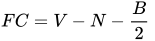
Formal charge (FC) : The electric charge assigned to an atom in a molecule, assuming that all electrons in all bonds are shared equally between atoms, regardless of each atom’s relative electronegativity. The formal charge of any atom that is part of a molecule can be calculated by the equation F C = V − N − B 2 {\displaystyle FC=V-N-{\frac {B}{2}}\ } , where V {\displaystyle V} is the number of valence electrons of the neutral atom in its ground state; N {\displaystyle N} is the number of valence electrons of the atom which are not participating in bonds in the molecule; and B {\displaystyle B} is the number of electrons shared in bonds with other atoms in the molecule.
Filtration : Any physical, biological, or chemical operation that separates large particles (often solid matter) from smaller particles (often a fluid) by passing the mixture through a complex lattice structure through which only particles of a sufficiently small size can pass, called a filter. The fluid and small particles which successfully pass through the filter are called the filtrate.
Flask : A vessel or container, most commonly a type of glassware, widely used in laboratories for a variety of purposes, such as preparing, holding, containing, collecting, or volumetrically measuring chemicals, samples, or solutions, or as a chamber in which a chemical reaction occurs. Flasks come in a number of shapes and sizes but are typically characterized by a wider vessel “body” and one or more narrower tubular sections with an opening at the top.
Faraday’s laws of electrolysis : A set of two laws pertaining to electrolysis which hold that: a) the mass of a substance altered at an electrode during electrolysis is directly proportional to the quantity of electricity transferred at that electrode; and b) the mass of an elemental material altered at an electrode is directly proportional to the element’s equivalent weight.
Faraday constant : A unit of electric charge widely used in electrochemistry which represents 1 mole of electrons: 6.022 × 10²³ electrons. It is equal to approximately 96,500 coulombs (F = 96 485.339 9(24) C/mol).
Extensive property : A physical quantity whose value is proportional to the size of the system it describes or to the quantity of matter in the system. Examples include mass, volume, enthalpy, and entropy. Contrast intensive property.
Freezing : The phase transition of a substance from a liquid to a solid.
Equilibrium : Universally, it is the condition of a system in which all competing influences are balanced. Chemical equilibrium is the state in which the concentrations of the reactants and products have stopped changing in time.
Eppendorf tube : A generalized and trademarked name used to refer to a microcentrifuge tube.
Empirical formula : Gives the simplest whole-number ratio of the atoms of each element present in a compound.
Equilibrium : Universally, it is the condition of a system in which all competing influences are balanced. Chemical equilibrium is the state in which the concentrations of the reactants and products have stopped changing in time.
Enzyme : A biological protein catalyst that speeds up a chemical reaction.
Entropy : The amount of energy not available for work in a closed thermodynamic system, usually symbolized by S.
Enthalpy : A measure of the total internal energy of a thermodynamic system, usually symbolized by H.
Enplethy : See amount of substance.
Energy : A system’s ability to do work.
Elementary reaction : Any chemical reaction in which one or more chemical species react directly to form products in a single reaction step and with a single transition state, i.e. without any intermediates. Contrast stepwise reaction.
Electrophile : Any atom or molecule which can accept an electron pair. Most electrophiles carry a net positive charge, include an atom carrying a partial positive charge, or include a neutral atom that does not have a complete octet of electrons, and therefore they attract electron-rich regions of other species; an electrophile with vacant orbitals can accept an electron pair donated by a nucleophile, creating a chemical bond between the two species. Because they accept electrons, electrophiles are Lewis acids by definition.
Element : A species of atoms having the same number of protons in their atomic nuclei and hence the same atomic number. Chemical elements constitute all of the ordinary matter in the universe; 118 elements have been identified and are organized by their various chemical properties in the periodic table of the elements.
Electronegativity (χ) : A chemical property that describes the tendency of an atom to attract a shared pair of electrons (or electron density) towards itself. An atom’s electronegativity is affected both by its nuclear charge (which is proportional to the number of protons in its nucleus) and the number and location of the electrons present in its atomic shells (which influences the distance of the nucleus from the valence electrons). The higher an atom or substituent‘s electronegativity, the more it attracts electrons towards itself. As it is usually calculated, electronegativity is not a property of an atom alone but rather of an atom within a molecule; it therefore varies with an element’s chemical environment, though it is generally considered a transferable property.
Electron shell : An orbital around the nucleus of an atom which contains a fixed number of electrons (usually two or eight).
Electron pair : Two electrons which occupy the same molecular orbital but have opposite spins. Electron pairs form chemical bonds or occur as lone pairs of valence electrons; it is also possible for electrons to occur individually as unpaired electrons.
Electron configuration : The distribution of the electrons of an atom or molecule within atomic or molecular orbitals. An extensive system of notation is used to concisely and uniquely display information about the electron configuration of each atomic species. Knowledge of the specific arrangements of electrons in different atoms is useful for understanding chemical bonds and the organization of the periodic table of the elements.
Electron : A type of subatomic particle with a net charge that is negative.
Electromagnetism : Fields with an electric charge and electrical properties that change the way that particles move and interact.
Electromagnetic radiation : A type of wave that can go through vacuums as well as material and is classified as a self-propagating wave.
Electrochemical cell :Using a chemical reaction’s current, electromotive force is made.
Electrolyte : A solution that conducts a certain amount of electric current and can be split categorically into weak and strong electrolytes.
Electric charge : A measured property (coulombs) that determines electromagnetic interaction.
Earth metal : See alkaline earth metal.
Ductility :
A measure of a material’s ability to undergo significant plastic deformation before rupturing, typically expressed as percent elongation or percent area reduction from a tensile test and popularly characterized by the material’s ability to be stretched into a wire.
Double bond : A bond involving the covalent sharing of two pairs of electrons.
Distillation : The process of separating the component substances of a liquid mixture by exploiting differences in the relative volatility of the mixture’s components through selective boiling and subsequent condensation. The apparatus used to distill a substance is called a still, and the re-condensed substance yielded by the process is called the distillate.
Dissolution :
The interaction of a solvent with the molecules or ions of a solute, involving bond formation, hydrogen bonding, and van der Waals forces.
Dipole moment : The polarity of a polar covalent bond.
Dispersion : A system in which particles of one material are distributed within a continuous phase of another material; the two phases may be in the same or different states of matter. Dispersions of particles sufficiently large for sedimentation are called suspensions, while those of smaller particles are called colloids or solutions.
Dipole : The electric or magnetic separation of charge.
Dimer : An oligomer consisting of two monomers joined by chemical bonds that may variably be strong or weak, covalent or intermolecular. A homodimer consists of two identical molecules; a heterodimer consists of two different molecules.
Diatomic molecule : Any molecule composed of only two atoms, of the same or different elements.
Diffusion : The net movement of atoms or molecules from a region of higher concentration to a region of lower concentration. Diffusion is driven by a gradient in chemical potential of the diffusing species and depends on the random walk of particles; hence it results in mixing or mass transport without required directed bulk motion.
Dewar flask : See vacuum flask.
Diatomic : Composed of two atoms, of the same or different elements. Contrast monatomic and polyatomic.
Denticity : The number of donor groups in a single ligand that bind to a central atom in a coordination complex.
Deposition : The settling of particles within a solution or mixture.
Delocalized electron : Any electron in a molecule, ion, or solid metal that is not associated with an individual atom or covalent bond. The term may refer to electrons involved in resonance in conjugated systems or aromatic compounds; to free electrons which facilitate electrical conductivity; or to electrons within delocalized molecular orbitals encompassing several adjacent atoms.
Density : An intensive property of a substance defined as mass per unit volume and expressed by the equation d = m/V.
Deionization : The removal of ions, and in water’s case, mineral ions such as sodium, iron, and calcium.
Deliquescence : A substance’s affinity for water, often characterized as its tendency to absorb moisture from the atmosphere to form aqueous solutions. Most strongly deliquescent substances are salts, such as calcium chloride and potassium carbonate.
Crystallography : The branch of chemistry concerned with determining the arrangement of atoms within crystalline solids.
Cuvette : A type of glassware used in spectroscopic experiments. It is usually made of plastic, glass, or quartz and should be as clean and clear as possible.
Critical point : The end point of a phase equilibrium curve or pressure–temperature curve at which conditions are such that phase boundaries vanish and a substance’s different phases, such as liquid and vapor, can coexist. The critical point is defined by the intersection of a critical temperature, Tc, and a critical pressure, pc; above this temperature and pressure, all distinction between phases disappears and the substance becomes a supercritical fluid.
Crystal : A solid whose constituent particles (such as atoms, ions, or molecules) are arranged in an orderly periodic microscopic structure, forming a lattice that extends in all directions. Such materials are often described as crystalline.
Coulomb : The SI unit of electric charge (symbol: C), defined as the charge transported by a constant current of one ampere in one second.
Covalent bond :
A bond that involves the sharing of electron pairs between atoms. The stable balance of attractive and repulsive forces that occurs between atoms when they share electrons is known as covalent bonding.
Sorrosion : An irreversible interfacial chemical reaction of a material with its environment which results in consumption of the material or dissolution into the material of an external component of the environment.
Conformation : The spatial arrangement of atoms affording distinction between stereoisomers which can be interconverted by rotations about formally single bonds.
Conductor : Any object or material that allows the flow of an electric current in one or more directions. Contrast insulator.
Conductor : Any object or material that allows the flow of an electric current in one or more directions. Contrast insulator.
Condosity : A comparative measurement of the electrical conductivity of a solution defined as the molar concentration of a sodium chloride (NaCl) solution that has the same specific electrical conductance as the solution under test. It is typically expressed in units of moles per litre (or per some other unit of volume).
Concentration : The abundance of a constituent of a mixture divided by the total volume of the mixture. Several different definitions of concentration are widely used in chemistry, including mass concentration, volume concentration, and molar concentration.
Condensation : The phase transition of a substance from a gas to a liquid.
Compound : A substance that is made up of two or more chemically bonded elements.
Compression : An area in a longitudinal wave where the particles are closer and pushed in.
Combustion : An exothermic reaction between an oxidant and a fuel that produces large amounts of heat and often light.
Colloid : A mixture of evenly dispersed substances, such as many milks.
Colligative property : Any property of a solution that depends upon the ratio of the number of solute particles to the number of solvent particles in the solution, and not on the nature of the chemical species present.
Cohesion : The tendency of similar particles or surfaces to cling to one another as a result of intermolecular forces. Contrast adhesion.
Chemistry : The scientific discipline that studies chemical substances, compounds, and molecules composed of atoms of various chemical elements, as well as their compositions, structures, properties, behaviors, and the changes they undergo during reactions with other substances.
Chemical synthesis : The artificial execution of one or more chemical reactions in order to obtain one or more products. In modern laboratory contexts, specific chemical syntheses are both reliable and reproducible.
Chemical substance :
A form of matter that has constant chemical composition and characteristic properties and which cannot be separated into simpler components by purely physical methods (i.e. without breaking chemical bonds). It is often called a pure substance to distinguish it from a mixture.
Chemical species:
A chemical substance or ensemble of substances composed of chemically identical molecular entities which can explore the same set of molecular energy levels on a characteristic or delineated time scale.
Chemical reaction : The change of one or more substances into one or more different substances.
Chemical process : 1. Any method or means of changing one or more chemicals or chemical compounds in any way, either naturally or artificially, spontaneously or by the actions of external forces.2. In chemical engineering, any method used on an industrial scale (especially in manufacturing) to change the composition of one or more chemicals or materials.
Chemical law : A law of nature relevant to chemistry, such as the law of conservation of mass.
Chemical formula : Any of various means of concisely displaying information about the chemical composition of a compound or molecule using letters, numbers, and/or typographical symbols. Chemical formulas, such as empirical and molecular formulas, can only indicate the identities and numerical proportions of the atoms in a compound and are therefore more limited in descriptive power than chemical names and structural formulas.
Chemical composition : The identity and relative number of the elements that make up a chemical compound, which can often be expressed with a chemical formula.
Chemical decomposition : The breakdown of a single particle or entity (such as a molecule or reactive intermediate) into two or more fragments, or a chemical reaction in which two or more products are formed from a single reactant. Contrast chemical synthesis.
Chelation : A type of bonding involving the formation of two separate coordinate covalent bonds between a polydentate ligand and a single central metal ion. The ligand is usually an organic compound called a chelant or chelating agent.
Charles’s law : When the pressure on a sample of a dry gas is held constant, the Kelvin temperature is directly proportional to its volume.
Charge number : A quantized value of electric charge calculated as the electric charge in coulombs divided by the elementary-charge constant, or z = q/e. Charge numbers for ions are denoted in superscript (e.g. Na+ indicates a sodium ion with a charge number of positive one). Atomic numbers are charge numbers of atomic nuclei.
Cell potential : The force in a galvanic cell that pulls electrons through a reducing agent to an oxidizing agent.
Centrifuge : A device used to separate substances based on size, shape, and density by centrifugation, or the rotation of vessels containing the substances around a centred axis at extremely high velocities.
Centrifugation : A laboratory technique which involves the application of centrifugal force to separate particles from a solution according to their size, shape, and density. Larger and/or denser substances migrate away from the axis of a centrifuge, while smaller and/or less dense substances migrate towards the axis.
Cation : A positively charged ion.
Cathode : An electrode from which the conventional electric current (the flow of positive charges) exits a polarized electrical circuit. Positively charged cations always move toward the cathode, though the cathode’s polarity can be positive or negative depending on the type of electrical device and how it is being operated. Contrast anode.
Calorimeter : A device used to measure heat.
Catalyst : Any element or compound that facilitates an increase in the speed of a chemical reaction but which is not consumed or destroyed during the reaction. It is considered both a reactant and a product of the reaction.
Burette :
Glassware used to dispense specific amounts of liquid when precision is necessary (e.g. during titrations and resource-dependent reactions).
Bumping: A phenomenon in which a homogeneous liquid raised to its boiling point becomes superheated and, upon nucleation, rapidly boils to the gas phase, resulting in a violent expulsion of the liquid from the container; in extreme cases, the container itself may shatter. Frequent stirring, the use of an appropriate container, and the use of boiling chips can help prevent bumping.
Buffered solution:
An aqueous solution consisting of a weak acid and its conjugate base or a weak base and its conjugate acid that resists changes in pH when strong acids or bases are added.
Brønsted–Lowry base : Any chemical species that readily accepts a proton.
Boyle’s law : For a given mass of gas at constant temperature, the volume varies inversely with the pressure.
Brønsted–Lowry acid : Any chemical species that readily donates a proton.
Bond : Any persistent attraction between atoms, ions, or molecules that enables the formation of chemical compounds. Bonds are created as a result of a wide variety of electrochemical forces, whose strengths can vary considerably; they are broken when these forces are overcome by other forces. The types, strengths, and quantities of bonds holding together chemical substances dictate the structure and bulk properties of matter.
Boiling-point elevation : the process where the boiling point is elevated by adding a substance