Mass : A property of physical matter that is a measure of its resistance to acceleration when a net force is applied. The SI base unit for mass is the kilogram (kg).
👇 ស្វែងរកឯកសាររៀននិងការងារគ្រប់ប្រភេទនៅទីនេះ៖
👇 ស្វែងរកពាក្យផ្សេងទៀតនៅប្រអប់នេះ៖
ACCA, MBA, Tax Agent ជាអ្នកនិពន្ធហើយអាចប្រលងជាប់៖ ACCA រហូត ៤ មុខវិជ្ជាក្នុងពេលតែម្តង, Tax Agent ពិន្ទុខ្ពស់, MBA & BBA ជាប់ជាសិស្សពូកែ និងមានបទពិសោធការងារជាង ១៥ ឆ្នាំ ព្រមទាំងអ្នកនិពន្ធផ្សេងៗ ?ទិញឯកសារហើយ អានមិនយល់អាចសួរបាន
Mass : A property of physical matter that is a measure of its resistance to acceleration when a net force is applied. The SI base unit for mass is the kilogram (kg).
Malleability : See ductility.
Manometer : An instrument used to measure pressure invented by Evangelista Torricelli in 1643.
London dispersion forces : A type of weak intermolecular force.
Liquid : One of the four fundamental states of matter, characterized by nearly incompressible fluid particles that retain a definite volume but no fixed shape.
Light :
The portion of the electromagnetic spectrum which is visible to the unaided human eye.
Ligand : An ion, functional group, or other molecule that binds to a central metal atom to form a coordination complex. Such bonding can range from covalent to ionic, but generally involves formal donation of one or more of the ligand’s electron pairs to the metal.
Leveling effect : The effect of a solvent on the chemical properties of acids or bases which are dissolved in the solvent. The strength of a strong acid is limited or “leveled” by the basicity of the solvent, and likewise the strength of a strong base is limited by the acidity of the solvent, such that the effective pH of the solution is higher or lower than might be suggested by the acid’s or base’s dissociation constant.
Lattice : The unique arrangement of atoms or molecules in a crystalline liquid or solid.
Kinetic energy : The energy of an object due to its motion.
Lanthanides :
The periodic series of metallic elements with atomic numbers 57 through 71, from lanthanum through lutetium.
Ketone : An organic compound with a carbonyl group between two carbon atoms.
Kinetics : A subfield of chemistry specializing in reaction rates.
Kelvin (K) : The SI base unit of temperature (symbol: K). The Kelvin scale is an absolute thermodynamic temperature scale that uses absolute zero as its null point.
Joule (J) : The SI unit of energy (symbol: J). One joule is defined as one Newton-meter.
Isotope : A variant of a particular chemical element which differs in the number of neutrons present in the nucleus. All isotopes of a given element have the same number of protons in each atom.
Isomers : Ions or molecules with identical chemical formulas but distinct structures or spatial arrangements. Isomers do not necessarily share similar properties. The two main types of isomers are structural isomers and stereoisomers.
Ionization : The breaking up of a chemical compound into separate ions.
Isoelectronicity : The phenomenon of two or more chemical species (atoms, molecules, ions, etc.) being composed of different elements but having the same number of valence electrons and the same structural arrangement (i.e. the same number of atoms with the same connectivity). Isoelectronic species typically show useful consistency and predictability in their chemical properties.
Ion : A molecule that has gained or lost one or more electrons from its neutral state and therefore possesses a negative or positive electric charge.
Ionic bond : An electrostatic attraction between oppositely charged ions.
International Union of Pure and Applied Chemistry (IUPAC) : An international federation of chemists that is recognized as the world authority in developing standards for chemical nomenclature and other methodologies in chemistry.
Intensive property : A physical quantity whose value does not depend on the size of the system or the quantity of matter for which it is measured. Examples include density, temperature, and pressure. Contrast extensive property.
Inorganic chemistry : The branch of chemistry concerning the chemical properties and reactions of inorganic compounds. Contrast organic chemistry.
Insulator : Any material that resists the flow of an electric current. Contrast conductor.
Inorganic compound : Any chemical compound that does not contain carbon, though there are exceptions. Contrast organic compound.
Induced radioactivity : radioactivity caused by bombarding a stable isotope with elemental particles, forming a radioactive isotope
Indicator : A special compound added to a solution that changes color depending on the acidity of the solution. Different indicators have different colors and are effective within different pH ranges.
Ideal solution : A solution for which the gas phase exhibits thermodynamic properties analogous to those of a mixture of ideal gases.
Ideal gas law : A chemical law which states that the volume of a gas is proportional to the amount of gas and its Kelvin temperature and inversely proportional to its pressure.
Ideal gas constant :
The proportionality constant in the ideal gas law, defined as 0.08206 L·atm/(K·mol).
Hydrolysis : The cleavage of a chemical bond by the addition of water.
Hydrogen bond : A form of electrostatic interaction between an electronegative atom and a hydrogen atom bound to a second electronegative atom. Hydrogen bonding is unique because the small size of the hydrogen atoms permits proximity of the interacting electrical charges, and may occur as an intermolecular or intramolecular force.
Hydrate : Any substance that contains water or its constituent elements, or any compound formed by the addition of water or its elements to another molecule.
Hess’ law of constant heat summation :
A law of physical chemistry which states that the total enthalpy change during the course of a chemical reaction is the same whether the reaction is completed in one step or in multiple steps.
Heat : Energy transferred from one system to another by thermal interaction.
Heat of fusion : See enthalpy of fusion.
Halogen : Any of the five non-metallic elements of Group 17 of the periodic table: fluorine (F), chlorine (Cl), bromine (Br), iodine (I), and astatine (At).
Hadron : A subatomic particle of a type including the baryons and mesons that can take part in the strong interaction.
Group :
A vertical column of the periodic table of the elements and the elements that share it. Contrast period.
Ground glass joint : An apparatus designed to quickly and easily fit two pieces of leak-tight glassware together, featuring ground glass surfaces and typically a custom-made conical taper.
Gram-atom : One gram-atom of an element is defined as a collection of 6.023X10^23 atoms.
Gibbs energy : A value that indicates the spontaneity of a reaction. Usually symbolized as G.
Geochemistry : The study of the chemistry and chemical composition of the Earth and geological processes.
Gay-Lussac’s law : A chemical law used for each of the two relationships derived by French chemist Joseph Louis Gay-Lussac and which concern the properties of gases, though the name is more usually applied to his law of combining volumes.
Gas chromatography : A type of chromatography commonly used in analytical chemistry to isolate and analyze chemical compounds that can be vaporized without decomposition. Gas chromatography is often used to test the purity of substances, to identify unknown substances, and to measure the relative amounts of the different components of mixtures.
Galvanic cell : A type of battery made up of electrochemicals with two different metals connected by a salt bridge.
Gas : One of the four fundamental states of matter, characterized by high-energy particles which fill their container but have no definite shape or volume.
Freezing point :
The temperature at which a substance changes state from a liquid to a solid. Because freezing is the reverse of melting, the freezing point of a substance is identical to its melting point, but by convention only the melting point is referred to as a characteristic property of a substance.
Frequency : A measurement of the number of cycles of a given process per unit of time. The SI unit for measuring frequency is the hertz (Hz), with 1 Hz = 1 cycle per second.
Free radical : See radical.
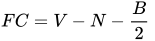
Formal charge (FC) : The electric charge assigned to an atom in a molecule, assuming that all electrons in all bonds are shared equally between atoms, regardless of each atom’s relative electronegativity. The formal charge of any atom that is part of a molecule can be calculated by the equation F C = V − N − B 2 {\displaystyle FC=V-N-{\frac {B}{2}}\ } , where V {\displaystyle V} is the number of valence electrons of the neutral atom in its ground state; N {\displaystyle N} is the number of valence electrons of the atom which are not participating in bonds in the molecule; and B {\displaystyle B} is the number of electrons shared in bonds with other atoms in the molecule.
Filtration : Any physical, biological, or chemical operation that separates large particles (often solid matter) from smaller particles (often a fluid) by passing the mixture through a complex lattice structure through which only particles of a sufficiently small size can pass, called a filter. The fluid and small particles which successfully pass through the filter are called the filtrate.
Flask : A vessel or container, most commonly a type of glassware, widely used in laboratories for a variety of purposes, such as preparing, holding, containing, collecting, or volumetrically measuring chemicals, samples, or solutions, or as a chamber in which a chemical reaction occurs. Flasks come in a number of shapes and sizes but are typically characterized by a wider vessel “body” and one or more narrower tubular sections with an opening at the top.
Faraday’s laws of electrolysis : A set of two laws pertaining to electrolysis which hold that: a) the mass of a substance altered at an electrode during electrolysis is directly proportional to the quantity of electricity transferred at that electrode; and b) the mass of an elemental material altered at an electrode is directly proportional to the element’s equivalent weight.
Faraday constant : A unit of electric charge widely used in electrochemistry which represents 1 mole of electrons: 6.022 × 10²³ electrons. It is equal to approximately 96,500 coulombs (F = 96 485.339 9(24) C/mol).
Extensive property : A physical quantity whose value is proportional to the size of the system it describes or to the quantity of matter in the system. Examples include mass, volume, enthalpy, and entropy. Contrast intensive property.
Freezing : The phase transition of a substance from a liquid to a solid.
Equilibrium : Universally, it is the condition of a system in which all competing influences are balanced. Chemical equilibrium is the state in which the concentrations of the reactants and products have stopped changing in time.
Eppendorf tube : A generalized and trademarked name used to refer to a microcentrifuge tube.
Empirical formula : Gives the simplest whole-number ratio of the atoms of each element present in a compound.
Equilibrium : Universally, it is the condition of a system in which all competing influences are balanced. Chemical equilibrium is the state in which the concentrations of the reactants and products have stopped changing in time.
Enzyme : A biological protein catalyst that speeds up a chemical reaction.
Entropy : The amount of energy not available for work in a closed thermodynamic system, usually symbolized by S.
Enthalpy : A measure of the total internal energy of a thermodynamic system, usually symbolized by H.
Enplethy : See amount of substance.
Energy : A system’s ability to do work.
Elementary reaction : Any chemical reaction in which one or more chemical species react directly to form products in a single reaction step and with a single transition state, i.e. without any intermediates. Contrast stepwise reaction.
Electrophile : Any atom or molecule which can accept an electron pair. Most electrophiles carry a net positive charge, include an atom carrying a partial positive charge, or include a neutral atom that does not have a complete octet of electrons, and therefore they attract electron-rich regions of other species; an electrophile with vacant orbitals can accept an electron pair donated by a nucleophile, creating a chemical bond between the two species. Because they accept electrons, electrophiles are Lewis acids by definition.
Element : A species of atoms having the same number of protons in their atomic nuclei and hence the same atomic number. Chemical elements constitute all of the ordinary matter in the universe; 118 elements have been identified and are organized by their various chemical properties in the periodic table of the elements.